- Top Pharma and Cosmetic Packaging Industry
- +91-94165 55583
- +91-7876111511
- highkick1819@gmail.com

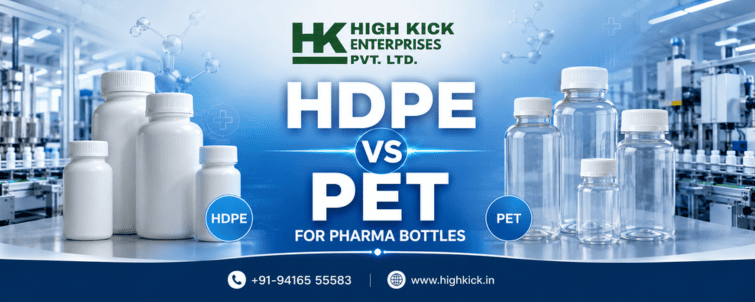
HDPE vs PET for Pharma Bottles

Top Tablet Container Manufacturers in India
July 14, 2026
PET Bottle Manufacturing Company in Zirakpur
July 14, 2026HDPE vs PET for Pharma Bottles: The Ultimate Selection Guide
In the pharmaceutical sector, packaging is never just a container. It is a critical shield that protects life-saving medications from environmental degradation. Consequently, deciding between HDPE vs PET for Pharma Bottles is a critical step for formulation scientists and packaging procurement officers alike. The choice you make directly impacts product shelf-life, molecular stability, and user safety.
At High Kick Enterprises, we understand that selecting the right material demands an in-depth understanding of polymer science and regulatory compliance. As a premier pharmaceutical packaging manufacturer, we maintain strict adherence to international quality standards. To simplify this decision, we have created this guide on HDPE vs PET for Pharma Bottles. Let us explore how these two dominant polymers perform under medical packaging requirements.
Key Takeaways
Before diving into the technical details, here are the essential points to guide your decision:
- HDPE (High-Density Polyethylene) offers unmatched moisture barrier protection, making it ideal for solid oral dosages like tablets and capsules.
- PET (Polyethylene Terephthalate) provides exceptional clarity and oxygen barrier properties, making it the preferred choice for liquid syrups and aesthetics-driven nutraceuticals.
- High Kick Enterprises manufactures both options using medical-grade, US FDA-compliant materials under strict GMP conditions.
Key Performance Metrics: HDPE vs PET for Pharma Bottles
When evaluating HDPE vs PET for Pharma Bottles, moisture transmission is a major factor. The molecular structures of both polymers dictate how they interact with external gases, light, and physical stress. Let us analyze these critical performance metrics in detail.
Moisture Barrier Differences in HDPE vs PET for Pharma Bottles
Moisture is the primary enemy of solid oral dosages, as water vapor can degrade active pharmaceutical ingredients (APIs). Therefore, understanding the moisture barrier differences in HDPE vs PET for Pharma Bottles is vital.
HDPE is a highly crystalline polymer with a density typically ranging from 0.941 to 0.967 g/cm³. This dense molecular structure provides an exceptional water vapor transmission rate (WVTR) of less than 0.3 g/m²/day under standard testing conditions. Because of this high density, HDPE serves as a strong barrier that blocks moisture. This characteristic makes it a standard choice for a reliable tablet container manufacturer.
On the other hand, PET is a semi-crystalline polyester. While it features a strong gas barrier, its WVTR is higher than that of HDPE, generally averaging around 1.5 to 2.0 g/m²/day. Consequently, PET requires specialized desiccants or multi-layer coatings if used for highly moisture-sensitive medications. This contrast is a defining aspect of HDPE vs PET for Pharma Bottles selection.
Chemical Compatibility of HDPE vs PET for Pharma Bottles
Another vital dimension to study is chemical compatibility. The diverse chemical structures of liquid medications require different types of plastic pharma bottles.
HDPE possesses outstanding resistance to a wide range of chemicals, including strong acids, bases, and mild solvents. This inertness stems from its non-polar aliphatic hydrocarbon chain. It prevents chemical leaching, which is why it remains a popular choice for a wide variety of medical packaging.
In comparison, PET possesses a polar ester group in its polymer backbone. Although it provides excellent resistance to diluted acids, oils, and alcohols, it can be sensitive to strong alkalis and highly polar solvents. Analyzing the chemical compatibility of HDPE vs PET for Pharma Bottles shows why both materials matter in pharmaceutical packaging.
What are HDPE Pharma Bottles?
High-Density Polyethylene (HDPE pharma bottles) represent the backbone of solid dosage packaging. They are opaque, rigid, and highly durable containers designed to protect dry formulations.
       [ Ethylene Monomer Polymerization ]
                      │
                      ▼
          [ High-Density Polyethylene ]
                      │
         (High Crystallinity: 70% to 80%)
                      │
                      ▼
     [ Excellent Moisture & Chemical Barrier ]
Technical Features
- High Density: High crystallinity (70% to 80%) provides high rigidity and tensile strength.
- Light Shielding: Can be easily pigment-infused (e.g., white or amber) to block harmful UV light up to 400 nm.
- Temperature Tolerance: Exhibits a wide thermal stability range, maintaining structural integrity up to 120°C for short durations.
Advantages
- Superb Moisture Shielding: Prevents hydrolysis in dry tablet formulations.
- Impact Resistance: Excellent drop-strength prevents breakage during long-distance transit.
- Cost-Efficiency: Economical raw material cost translates to lower unit pricing for bulk productions.
Common Pharmaceutical Applications
- Tablets and capsules
- Dry powder inhalers (DPIs) and granules
- Diagnostic reagent kits
- Veterinary medicines requiring chemical-resistant packaging
The selection of HDPE vs PET for Pharma Bottles often depends on physical properties like transparency and flexibility. Many solid dosage forms, manufactured by High Kick Enterprises, utilize HDPE to maximize shelf-life.
What are PET Pharma Bottles?
Polyethylene Terephthalate (PET pharma bottles) are renowned for their glass-like transparency and exceptional gas barrier properties. They offer an elegant, safe, and lightweight alternative to traditional glass.
 [ Terephthalic Acid + Ethylene Glycol ]
                     │
                     ▼
       [ Polyethylene Terephthalate ]
                     │
         (Amorphous or Semi-Crystalline)
                     │
                     ▼
   [ Outstanding Oxygen Barrier & High Clarity ]
Technical Features
- Optical Clarity: High light transmission provides excellent product visibility.
- Outstanding Gas Barrier: Extremely low oxygen transmission rate (OTR), preventing oxidation of liquid APIs.
- Tensile Strength: High impact resistance prevents cracking or shattering under pressure.
Advantages
- Aesthetic Appeal: Gives a premium, clean look that enhances brand identity.
- Shatter-Resistant Safety: Eliminates the risk of glass-related injuries and contamination in production lines.
- Lightweight Profile: Reduces shipping costs compared to heavy glass alternatives.
Common Pharmaceutical Applications
- Cough syrups, liquid suspensions, and oral drops
- Nutraceutical vitamins and dietary supplements
- Injectable liquid solutions (under specific grades)
- Eye drops and topical lotions
When analyzing HDPE vs PET for Pharma Bottles, PET represents clarity and gas preservation. High Kick Enterprises designs clear, light-blocking amber, and custom-colored PET containers to meet diverse pharmaceutical requirements.
Detailed Comparison: HDPE vs PET for Pharma Bottles
To help you make an informed decision, this comparison of HDPE vs PET for Pharma Bottles outlines their technical properties, chemical resistances, and manufacturing processes.
| Comparative Parameter | HDPE Bottles | PET Bottles |
|---|---|---|
| Material Classification | Thermoplastic Polyolefin | Thermoplastic Polyester |
| Optical Transparency | Opaque to Translucent | Glass-like Clarity (Transparent) |
| Tensile Strength & Rigidity | High flexibility, crack-resistant | High rigidity, tension-resistant |
| Moisture Resistance (WVTR) | Excellent (Ideal for dry solids) | Moderate (Requires desiccants for sensitive solids) |
| Oxygen & Gas Barrier (OTR) | Moderate (Permeable to certain gases) | Excellent (Prevents liquid oxidation) |
| Chemical Resistance | Extremely high (Acids, Bases, Solvents) | High (Good for oils and diluted acids) |
| Average Container Weight | Lightweight | Extremely Lightweight |
| Unit Production Cost | Highly Cost-Effective | Economical to Premium (depending on clarity) |
| Impact Durability | Exceptional (Absorbs high impact) | High (Durable but scratch-prone) |
| Recyclability Code | resin identification code (RIC) #2 | resin identification code (RIC) #1 |
| Manufacturing Process | Injection Blow Molding (IBM) / EBM | Injection Stretch Blow Molding (ISBM) |
| Primary Pharmaceutical Use | Tablets, Capsules, Powders | Liquid Syrups, Drops, Nutraceuticals |
| Shelf-Life Protection | Prevents moisture-driven degradation | Prevents oxidative degradation |
This table, developed by High Kick Enterprises, provides a detailed guide to choosing the right polymer based on your specific drug delivery system.
Advantages of HDPE Pharma Bottles
An in-depth look at HDPE vs PET for Pharma Bottles shows that HDPE has superior impact strength and moisture resistance.
- Superior Hydrolysis Protection: It blocks moisture vapor, preserving dry powder active ingredients.
- UV Shielding Capability: White or amber-pigmented HDPE blocks light transmission, preventing photodegradation of sensitive compounds.
- High Stress-Cracking Resistance: HDPE resists environmental stress-cracking, maintaining pack integrity even during temperature changes.
- High-Speed Line Compatibility: Rigid, uniform HDPE walls prevent deformation on high-speed filling lines, reducing downtime.
High Kick Enterprises manufactures HDPE bottles using advanced machinery, ensuring every batch meets the strict standards expected of a top HDPE bottle manufacturer in India.
Advantages of PET Pharma Bottles
Conversely, the study of HDPE vs PET for Pharma Bottles highlights PET’s optical beauty and gas barrier properties.
- Glass-Like Premium Appearance: High transparency allows consumers to verify product volume and consistency, which builds patient trust.
- Superior Gas Barrier Properties: PET protects liquid syrups from oxygen ingress, preventing oxidation and flavor changes.
- High Dimensional Stability: Injection Stretch Blow Molding (ISBM) creates highly consistent bottle necks, ensuring leak-proof sealing with child-resistant caps.
- Excellent Sustainable Profile: PET is highly recyclable worldwide, helping pharmaceutical brands achieve their corporate sustainability goals.
Furthermore, High Kick Enterprises designs PET bottles with high precision, making us a leading PET bottle manufacturer in India for demanding pharma brands.
Which Material is Better for Pharmaceutical Packaging?
Selecting between HDPE vs PET for Pharma Bottles depends on the specific drug formulation, storage conditions, and target audience.
                                [ Pharmaceutical Formulation ]
                                              │
                     ┌────────────────────────┴────────────────────────┐
                     ▼                                                 ▼
             [ Dry/Solid Dosage ]                              [ Liquid/Syrup Dosage ]
              (Tablets, Capsules)                            (Suspensions, Solutions)
                     │                                                 │
                     ▼                                                 ▼
            [ Recommend: HDPE ]                               [ Recommend: PET ]
Dry Tablets and Capsules
For dry tablets and capsules, moisture protection is the top priority. HDPE remains the industry standard because of its excellent water vapor barrier. Using HDPE for solid oral dosages protects against moisture-driven chemical breakdown.
Liquid Syrups and Oral Suspensions
In contrast, liquid formulations need protection against gas ingress and evaporation. PET is the preferred choice for liquid mixtures, as its low oxygen transmission rate prevents degradation while maintaining a clean, professional look.
Nutraceuticals and Vitamins
Nutraceutical brands often prefer PET for its high visual appeal. It allows consumers to see colorful capsules or gummies, which can boost sales, while still providing necessary protection.
Veterinary Medicines and Agri-pharma
Veterinary pharmaceuticals often contain strong chemicals or oils. For these applications, HDPE is the standard choice due to its high chemical resistance.
High Kick Enterprises provides custom recommendations based on laboratory stability tests, ensuring your plastic pharma bottles deliver optimal performance.
Why Choose High Kick Enterprises?
If you are looking for a reliable pharmaceutical packaging manufacturer, High Kick Enterprises delivers quality and regulatory compliance at every step.
 ┌────────────────────────────────────────────────────────┐
 │             High Kick Enterprises Advantage            │
 ├────────────────────────────────────────────────────────┤
 │  ✔ US FDA-Compliant Food-Grade Materials               │
 │  ✔ ISO 9001:2015 & GMP Certified Cleanroom Facilities  │
 │  ✔ State-of-the-Art Injection Blow Molding (IBM) Tech  │
 │  ✔ Leak-Proof Closure Systems & Custom Options         │
 │  │  (Wide Range of Sizes: 10ml to 1000ml)              │
 │  ✔ PAN India Supply Chain with On-Time Logistics       │
 └────────────────────────────────────────────────────────┘
At High Kick Enterprises, we merge advanced technology with strict quality control. Our manufacturing process features:
- Premium Pharmaceutical Packaging: We build our reputation on precision, consistency, and cleanroom manufacturing standards.
- GMP-Compliant Manufacturing: Our production lines operate under strict hygiene conditions, preventing particulate or microbial contamination.
- Modern Injection Blow Molding (IBM) Technology: This process guarantees uniform wall thickness, zero neck flashes, and high structural stability.
- Custom Sizes and Colors: We provide custom packaging options, including amber, cobalt blue, and opaque white, tailored to your brand needs.
- Competitive Bulk Pricing: Our efficient, high-volume production lines allow us to offer competitive wholesale pricing.
- PAN India Supply Chain: We ensure reliable delivery to major pharmaceutical hubs across India.
Frequently Asked Questions (FAQs)
1: What is the main structural difference in HDPE vs PET for Pharma Bottles?
The main difference lies in their molecular structures. HDPE is a highly crystalline, non-polar polyolefin, which gives it an opaque appearance and an excellent moisture barrier. In contrast, PET is an amorphous polyester, which provides crystal-clear transparency and superior resistance to oxygen transmission.
2: Which bottle is better for moisture-sensitive tablets?
HDPE is much better for moisture-sensitive tablets. Its very low water vapor transmission rate (WVTR) prevents moisture from entering, protecting tablets and dry powders from hydrolytic degradation.
3: Are HDPE pharma bottles recyclable?
Yes, HDPE is highly recyclable and falls under resin identification code (RIC) #2. Recycled HDPE (rHDPE) can be processed into non-clinical plastic items, helping to lower the industry’s environmental footprint.
4: Are PET bottles safe for liquid medicines?
Yes, PET is fully safe for liquid medicines. It is highly inert, US FDA-approved, and does not leach harmful chemicals like Bisphenol A (BPA) into liquid medicines.
5: Which option provides better moisture protection in HDPE vs PET for Pharma Bottles?
HDPE provides significantly better moisture protection. Its water vapor transmission rate is about 5 to 7 times lower than that of PET, making it the preferred choice for dry formulations.
6: Which bottle is more cost-effective for large production runs?
HDPE is generally more cost-effective for high-volume manufacturing. This is because the raw polymer is less expensive and can be processed efficiently on high-speed blow molding lines.
7: Why choose High Kick Enterprises for your pharma packaging needs?
High Kick Enterprises stands out because we offer state-of-the-art, GMP-compliant cleanroom manufacturing, high-quality testing, custom design options, and a reliable PAN India supply chain.
8: Which material is best for high-volume HDPE vs PET for Pharma Bottles in India?
The best material depends on your product type. For tablets, capsules, and dry syrups, HDPE is the standard in India. For liquid cough syrups, suspensions, and pediatric drops, PET is the preferred choice.
9: How does cost factor into the choice of HDPE vs PET for Pharma Bottles?
Generally, HDPE has a lower raw material cost, making it highly economical for bulk tablet packaging. While PET can be slightly more expensive due to processing requirements, it reduces shipping costs because it is lightweight compared to glass.
Conclusion
In conclusion, selecting HDPE vs PET for Pharma Bottles demands a careful balance of chemical needs, barrier requirements, and branding goals. HDPE provides excellent moisture protection and durability, while PET offers outstanding gas protection and clarity.
Partnering with High Kick Enterprises guarantees that your pharma containers will meet strict regulatory standards. We provide high-quality packaging designed to keep your products safe and effective.
To get the best HDPE vs PET for Pharma Bottles solutions, contact High Kick Enterprises today. Let our experts assist you in choosing, testing, and scaling your next medical packaging run.
